Enabling A
Sustainable Asia Today

Overview
The world is at an inflection point to limit global warming and align with the 1.5°C pathway.
Infrastructure plays a critical role in facilitating the transition in advancing Asia’s journey towards a low-carbon future. Southeast Asia and South Asia have witnessed rapid improvements in their infrastructure, which have not only propelled economic growth but also alleviated poverty.
Both regions' economic advancements will continue over the next decade, supported by their growing population, increased urbanisation and industrialisation. By focusing our collaborative efforts and resources on developing sustainable and climate-resilient infrastructure, we can secure a better environment for both present and future generations.

Executive Summary
The ASIA Panel report uncovers valuable insights, strategies and opportunities to scale sustainable infrastructure and unlock financing in Asia. Drawing on a mix of perspectives from the public and private sectors, the report provides the latest thinking, best practices and case studies that demonstrate how organisations are accessing capital and creating project opportunities in the region.
Seizing Opportunities in Infrastructure Development
Catch the key report highlights from Ms Indranee Rajah, Minister in the Prime Minister’s Office, Second Minister for Finance and National Development, Singapore and the ASIA Panel members.
4 Key ENABLERS
Scale Sustainable Infrastructure with Proven Technologies
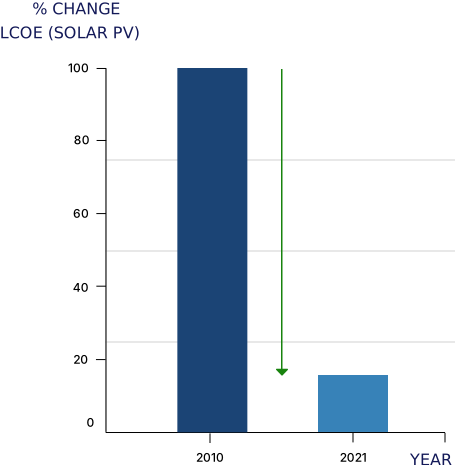
SOLAR LEADS THE WAY FOR DECARBONISATION AND MEETING ENERGY NEEDS
Among proven technologies out in the market, solar photovoltaics (PV) stands out as the most viable renewable energy option due to its large generation potential and cost-effectiveness.
Solar power boasts a generation potential that is ten times greater than the next most viable renewable resource in Southeast Asia. Additionally, it is one of the most cost-effective options, with the weighted-average levelised cost of energy (LCOE) for utility-scale solar PV dropped by 88% to USD 0.046/kWh in 2021.
As such, this positions solar deployment as a near-term decarbonisation strategy, hence allowing for the planning of higher-investment energy projects like wind and hydropower in the medium term.

Invest in Brownfield Assets to Reap Outsized Gains
CONSTRUCTION 0 % BUILDING
OPERATIONS
DISTRICT COOLING SYSTEMS CAN REAP LARGE SAVINGS POTENTIAL
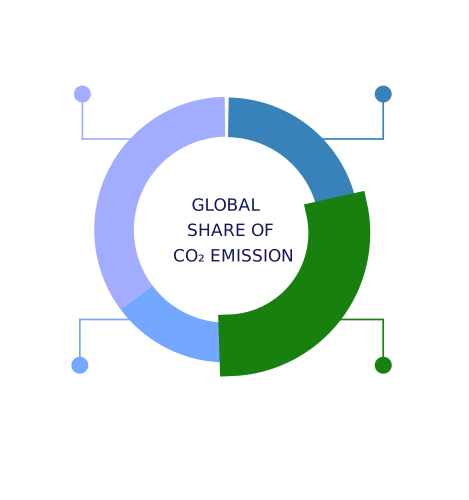
Building operations were responsible for 28% of global energy-related greenhouse gas emissions, according to the 2022 Global Status Report for Buildings and Construction. A significant portion was attributed to the use of air conditioners and fans to meet space cooling needs.
Efficiency in cooling can be achieved through a district cooling system that leverages economies of scale. Instead of each building having its individual chiller plant, a centralised cooling facility produces chilled water on a large scale and distributes it through a network of pipes to all buildings.
Buildings connected to this centralised system enjoy several benefits, including reduced carbon emissions and equipment costs, improved energy efficiency, energy savings, and the availability of freed-up space for other uses.

Ensure Strong Governance and Consistency in Standards
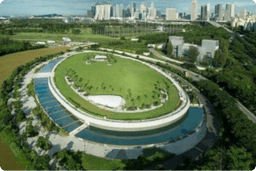 Photo Credits: Keppel
 The large-scale, dual-mode Keppel Marina East Desalination Plant is the first of its kind in Singapore, with an innovative design situating treatment equipment completely underground and featuring a lush green rooftop for community recreation.
ADOPTING SYSTEMS THINKING FOR LONG-TERM SUSTAINABLE URBAN PLANNING
Rapid urbanisation and population growth are placing immense stress on existing water, wastewater, and solid waste management infrastructure, which is now operating at or near full capacity. This challenge is further exacerbated by the competing demands for land, with residential and commercial developments expanding at the edges of cities.
There needs to be a mindset shift, by moving away from addressing these issues with short-term, isolated solutions, and toward embracing a broader circular economy approach. By promoting the circularity of water and waste, cities can optimise their use of land and financial resources to ensure long-term resilience. Infrastructure designed with an integrated approach can maximise connectivity, functionality and sustainability in meeting the public infrastructure needs.

Engage Alternative Funds to Supplement Existing Capital Pools
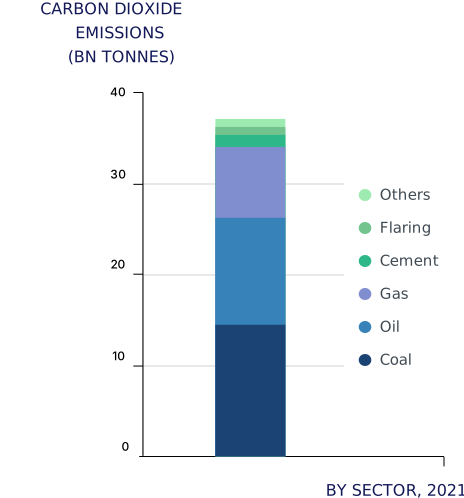
TRANSITIONARY FINANCING MECHANISMS FOR EARLY COAL PLANT RETIREMENT
Asia's extensive coal fleet is relatively young, with an average age of thirteen years. If these coal plants are allowed to operate until the end of their natural lifespan, they could release hundreds of billions of tonnes of carbon emissions and undermine climate mitigation efforts.
Governments and plant owners can collaborate with Infrastructure Asia and other international partners to improve bankability by blending concessionary capital.
There is a growing consensus in the market that end-users also bear a responsibility to facilitate the transition to lower-carbon energy generation. This aligns with the emerging pool of alternative investments from family offices and philanthropic funds committed to sustainability.
Key Infrastructure Pillars
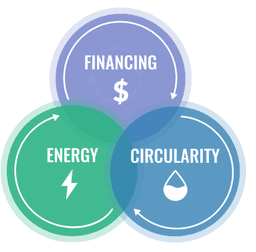
Energy, Circularity, and Financing constitute the essential infrastructure that support modern society. They provide vital services, economic stability, and address challenges arising from climate change and population growth in Southeast Asia and South Asia.
Ensuring the resilience of these key pillars boosts trust and confidence in public-private partnerships (PPPs). Governments can further bolster and stimulate their local economies, hence fostering economic growth. Trust and confidence in these key pillars are imperative for building safe, secure, and prosperous societies.







PAVING THE WAY FORWARD FOR SUSTAINABLE INFRASTRUCTURE
Transitioning to a low-carbon economy requires more than just government investments and initiatives. Through fostering strong partnerships and collaborations between public and private sectors, Infrastructure Asia brings together industry players across the infrastructure value chain to advance sustainable infrastructure development in the region.


Hear from our partners

Developing sustainable infrastructure is a key step towards low-carbon transition for Asia, a region that remains disproportionately affected by the immediate impacts of climate change. There is no silver bullet in this transition path; it will require steady commitment from all stakeholders to ensure our bold ESG ambitions are underpinned by robust transition plans – including a clear regulatory framework, policy incentives, and close collaboration between the public and private sectors to enhance commercial viability of sustainable infrastructure projects and boost investor confidence. Unlocking private financing, harnessing the great potential represented by the USD 100 trillion in global private capital under management, will significantly accelerate the transition to a low-carbon economy.
Mr Satish Shankar
Asia-Pacific Regional Managing Partner,
Bain & Company
At PIDG, we are excited to see that the ASIA Panel Report and the PIDG 2030 Strategy are aligned in identifying early-stage blended finance investments and the development of capital markets as key steps towards improving the bankability of infrastructure projects in South and Southeast Asia. We look forward to collaborating with Asian governments, financial institutions, and developers in bridging these gaps together.
Mr Philippe Valahu
CEO,
The Private Infrastructure Development Group (PIDG)
A very insightful read, the ASIA Panel Report highlights key matters and helps to shape the readers’ mindset towards core issues and solutions. Waste, water, and wastewater management solutions are crucial to governments and industries and investing in resilient technologies for an integrated approach towards circular economy, combined with strong long-term partnerships among diverse stakeholders is indeed the way forward to positive environmental change. Awareness is the first step that the report serves, and I hope to meet more like-minded people to discuss our learnings.
Mr Farchad Kaviani
Managing Director of Southeast Asia,
SUEZ
“Enabling a Sustainable Asia Today” illuminates the transformative power of proven energy efficiency solutions. Leveraging these proven solutions with unique business models like “shared savings” or “energy performance contracting”, asset owners could decarbonise both brown and green field assets at zero cost upfront investment.
Mr Hoe Boon Chye
CEO,
bbp
For the region to transition to a low-carbon economy, more than US$1.8 trillion of climate-related investment is called for to meet sustainable development goals. Stepping up to the challenge will require effective channelling of not just renewable energy but also financial resources in order to create a tide that can lift all boats. I am glad to see that Singapore is taking a lead in this regard. I also believe that the coming together of infrastructure as well as energy sector professionals and private capital market players will play a pivotal role in catalysing energy transition across the region.